Sunday, February 8, 2015

The True Story of the Three Little Pigs by Jon Scieszka

 The True Story of the Three Little Pigs by Jon Scieszka
 
Bibliography:
Scieszka, Jon, and Lane Smith. 1989. The true story of the 3 little pigs. New York, N.Y., U.S.A.: Viking Kestrel.
ISBN: 0670827592
Plot Summary: The True Story of the Three Little Pigs is told from the point of view of the wolf, and begins with the wolf claiming his innocence for his involvement with The Three Little Pigs. He says that he “was making a birthday cake for his dear old granny” and that he had a “terrible sneezing cold [and] ran out of sugar”. Then, he goes to his neighbor which happens to be a pig who built his house out of straw. In the process, he has a sneezing attack and the house falls down, he “accidentally” eats the pig and then goes to his next neighbor, which is the pig’s brother. This pig made his house out of sticks and the wolf has another sneezing attack causing the house to fall down. He thinks the pig has died, and eats him. After this, he goes to the next pig’s house that is made of bricks. The pig upsets the wolf by talking about his grandmother, and he tries to get in the house but is unable to, and the cops arrest the wolf and put him in jail for eating the other two pigs. The wolf insists that he is innocent and just needed a cup of sugar.
Critical Analysis: This story is told from the point of view of the wolf and is a surprising variation of the classic tale, The Three Little Pigs. Throughout the text, the wolf is seen as the antagonist, however, he tries to be seen as the protagonist when he states that he was trying to “make a cake for his dear old granny” and “ran out of sugar”.  The plot remains simple and direct and is full of action when the wolf sneezes and blows down the pig’s houses. The initial setting is vague, but becomes quickly established when the wolf goes to the houses of the pigs. The illustrations in the text are vivid and imaginative with a touch of realism. The lines within the illustrations add depth to the overall look and feel of the book. The total composition of the book is arranged in a way that sets the mood in favor of the wolf’s story of blowing down, and eating the pigs on accident in search of a cup of sugar to make his grandmother a cake.
Review Excerpts:
·         From Publishers Weekly - "Designed with uncommon flair," said PW, this "gaily newfangled version of the classic tale" takes sides with the villain. "Imaginative watercolors eschew realism, further updating the tale." Ages 3-8.
·         From School Library Journal - Grade 1 Up--Victim for centuries of a bad press, Alexander ("You can call me Al") T. Wolf steps forward at last to give his side of the story. Trying to borrow a cup of sugar to make a cake for his dear old Granny, Al calls on his neighbors--and can he help it if two of them built such shoddy houses? A couple of sneezes, a couple of dead pigs amidst the wreckage and, well, it would be shame to let those ham dinners spoil, wouldn't it? And when the pig in the brick house makes a nasty comment about Granny, isn't it only natural to get a little steamed? It's those reporters from the Daily Pig that made Al out to be Big and Bad, that caused him to be arrested and sent to the (wait for it) Pig Pen. "I was framed," he concludes mournfully. Smith's dark tones and sometimes shadowy, indistinct shapes recall the distinctive illustrations he did for Merriam's Halloween ABC (Macmillan, 1987); the bespectacled wolf moves with a rather sinister bonelessness, and his juicy sneezes tear like thunderbolts through a dim, grainy world. It's the type of book that older kids (and adults) will find very funny.
-John Peters, New York Public Library
·         From Booklist - Jon Scieszka's The True Story of the Three Little Pigs (1989) turned the favorite porkers' story upside-down by allowing the grossly misjudged wolf to tell his side of the story. Wiesner's latest is a post-modern fantasy for young readers that takes Scieszka's fragmentation a step further: it not only breaks apart and deliciously reinvents the pigs' tale, it invites readers to step beyond the boundaries of story and picture book altogether.
Connections/Activities:
·         Students can read multiple versions of the Three Little Pigs and create a Venn Diagram.
·         Students can perform a reader’s theater.
·         Students can explore point of view.
·         Students can write their own version of the three little pigs.
·         Students can change the ending of the story.
·         Students can examine the traditional tale of The Three Little Pigs before reading the story, and then create a foldable of the differences between the texts.
·         Have the students write a letter to the wolf.
·         Students can do an author study of Jon Scieszka.
·         Select other books by Jon Scieszka:
o   The Book That Jack Wrote – 978-0140553857
o   The Stinky Cheese Man and Other Fairly Stupid Tales – 978-0670844876
o   The Frog Prince, Continued - 978-0140542851
o   Squids Will Be Squids- 978-0142500408
·         Related Texts
o   The Three Little Pigs by James Marshall - 978-0448422886
o   The Three Little Aliens and The Big Bad Robot by Margaret McNamara -
    978-0375866890
o   The Three Little Pigs by Steven Kellogg - 978-0064437790
o   The Three Little Wolves and the Big Bad Pig by Eugene Trivizas- 978-0689815287
Personal Connections: The True Story of the Three Little Pigs has been a staple in my classroom library even before I became a teacher. I remember reading this story in Elementary school, and it is one of my favorite adaptations of The Three Little Pigs. I use this story when teaching point of view and when comparing fictional stories. My students love this book, and we have used it as a Reader’s Theater to practice reading fluency. I think this is a great book with many teaching points, and should be a staple in any language arts classroom.


Beautiful Blackbird by Ashley Bryan

 
Beautiful Blackbird by Ashley Bryan

Bibliography:
Bryan, Ashley. 2003. Beautiful blackbird. New York: Atheneum Books for Young Readers.
ISBN: 9780689847318
Plot Summary: This is an African folktale about the birds of Africa. In the beginning, the birds are colorful and consist of all the colors of the rainbow. One day, the birds go to a festival in the forest. Here they see the blackbird, and think that it is the most beautiful bird because it “stands out best of all”. The birds dance and sing. However, they want to look just like the blackbird. The blackbird then brings his blackening medicine gourd and paints the birds with black.  
Critical Analysis: The African folktale Beautiful Blackbird is a colorful story about individuality and being yourself. The author draws the reader’s attention by using a bright and vibrant paper collage effect to tell the story of the beautiful blackbird. The overarching theme of the story is that all living creatures are unique and beautiful and that all living things should be proud of who they are, and where they come from. The blackbird shares his “blackness” with the other colorful birds with the premise that the “color on the outside is not what’s on the inside”. The blackbird “gives until it all gives out” and is able to color all of the birds with the black medicine gourd. The folktale is centered around the character of the blackbird, who like many folktale characters is unchanging throughout the story and represents the goodness that all people share. The tale takes place in a forest in Africa and relies on the theme of acceptance which runs rampant throughout the story. The tale also reflects the culture and identity of the African people. This folktale consumes the reader and exemplifies the aspect that true beauty comes from within.
Review Excerpts:
·         From Publishers Weekly - Storyteller Bryan's (What a Wonderful World) singular voice provides rhythm and sound effects throughout this musical adaptation of a Zambian tale. When gray Ringdove calls the other monotone birds together and asks, "Who of all is the most beautiful?" they all reply, "Blackbird." They then encircle Blackbird, dancing and singing, "Beak to beak, peck, peck, peck,/ Spread your wings, stretch your neck./ Black is beautiful, uh-huh!/ Black is beautiful, uh-huh!" At the birds' request, Blackbird agrees to paint black markings on them (with the blackening brew in his medicine gourd), but he warns Ringdove that it's not the color black that will make them beautiful. "Color on the outside is not what's on the inside..... Whatever I do/ I'll be me and you'll be you." The message about inner beauty and identity becomes somewhat diluted by the closing song, in which the birds triumphantly sing, "Our colors sport a brand-new look,/ A touch of black was all it took./ Oh beautiful black, uh-huh, uh-huh/ Black is beautiful, UH-HUH!" But if the ending creates a bit of confusion, Bryan's collages make up for it with their exhibition of colorful splendor and composition. Scenes of the rainbow of wings are outdone only by a lakeside view of their colors intricately "mirrored in the waters." And Bryan's lilting and magical language is infectious. Ages 3-7.

·         From School Library Journal - Kindergarten-Grade 2-Because they haven't got a spot of black on their bodies, the colorful birds of Africa envy Blackbird. They extol his feathers that "gleam all colors in the sun" in their songs and dances. And although he assures them that "Color on the outside is not what's on the inside," he generously shares the blackening brew in his gourd. First he adds a necklace of midnight to Ringdove, then markings of black to every feathered creature large and small, causing them to finally sing, "Oh beautiful black, uh-huh, uh-huh/Black is beautiful, UH-HUH!" Adapted from an Ila tale from Zambia, this story delivers a somewhat contradictory message. Blackbird frequently affirms that it's what's inside that counts but his avian friends are certainly fixated on adding some black to their feathered finery. The story line is simple and the rhythmic chants of the flock frequently interspersed throughout the text add drama and a rapper's cadence. The cut-paper silhouettes are colorful but static, effectuating a stylized formality. The endpapers include an image of the scissors used to create the collages and reinforce the physical process behind the art. This unusual and little-known pourquoi tale may supplement larger collections and serves as a thoughtful and entertaining addition to units on self-esteem. Carol Ann Wilson, Westfield Memorial Library, NJ
 
·     From Booklist - K-Gr. 2. In this simple adaptation of a tale from the Ila-speaking people of Zambia, the message is clear: "Black is beautiful." Once upon a time, Blackbird was the only bird of Africa who wasn't brightly colored. When Ringdove asks who is the most beautiful bird, the other birds name Blackbird. At Ringdove's request, Blackbird brings blackening from his medicine gourd to decorate Ringdove's colored neck; the other birds also want trimming, so Blackbird paints dots and brushes lines and arcs until his gourd is empty. Using a more vivid palette than usual, Bryan employs boldly colored, cut-paper artwork to dramatize the action. The overlapping collage images fill the pages with energy as the songlike responses of the birds tap out a rhythm punctuated with "uh-huhs." In an author's note, Bryan explains that the scissors pictured on the endpapers, which Bryan used to create the collages, were once also used by his mother. Ready-made for participative storytelling. Julie Cummins
Connections/Activities:
Coretta Scott King Award for Illustration - 2004
·         Students can read other African folktales and compare and contrast storylines.
·         Students can create a Reader’s Theater and act out the folktale.
·         Students can create their own blackbirds and decorate them.
·         Students can write their own folktale based off the book.
·         Students can discuss true beauty coming from within.
·         Select other texts by Ashley Bryan
o   Let it Shine - 978-0689847325
o   Ashley Bryan: Words to My Life’s Song - 978-1416905417
o   All Things Bright and Beautiful - 978-1416989394
o   The Night Has Ears: African Proverbs - 978-0689824272
o   Ashley Bryan’s African Tales, Uh-Huh - 978-0689820762
·         Related Texts
o   Why Mosquitoes Buzz in People’s Ears: A West African Tale by Verma Aadema and Leo Dillon -  978-0140549058
o   Anansi the Spider: A Tale from the Ashanti by Harcourt School Publishers - 978-0805003116
o   Zomo the Rabbit: A Trickster Tale from West Africa by Gerald McDermott - 978-0152010102
Personal Connections: This is a great story to read when discussing folktales with students of all ages. It would be great to use in a unit over African folktales and comparing/contrasting different texts.

Thursday, January 29, 2015

Edwina, The Dinosaur Who Didn't Know She Was Extinct By Mo Willems

Edwina, The Dinosaur Who Didn't Know She Was Extinct By Mo Willems

Bibliography:

Willems, Mo. 2006. Edwina, the dinosaur who didn't know she was extinct. New York: Hyperion Books for Children.

ISBN: 0786837489

Plot Summary: This story is about a dinosaur named Edwina who lives among humans. She plays with neighborhood kids, does favors for people, and is seen as very polite. Everyone loves her except a little boy named Reginald. Reginald thinks that he knows everything and has to tell people that he knows everything. So, one day he decides to tell his class that dinosaurs are extinct. However, all of his classmates question him about Edwina and he gets upset that no one believes him about dinosaurs. He then decides to tell the entire town that dinosaurs are extinct. He does this by making flyers and protesting, but no one listens to him until he comes across Edwina. He tries his hardest to convince Edwina that dinosaurs are extinct, and eventually does, but she doesn’t care, and in the end of the story neither does Reginald.

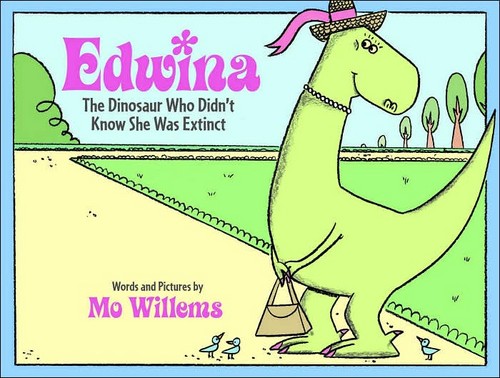
Critical Analysis: This text draws reader’s attention by the title of the story and beautifully illustrated cover. From the beginning of the text, we are introduced to Edwina, the main character in the story. She is loving, polite, helpful, and above all makes chocolate chip cookies for the town. However, there is one problem, how is a dinosaur living amongst the people in this town? Shouldn’t they be extinct? The townspeople do not see this, but a young boy named Reginald does. He is the classic know- it- all child who tries to persuade the townspeople that dinosaurs are extinct. They question him since Edwina is a member of their little town, but as any know-it-all child, he persists and makes flyers and protests about dinosaurs being extinct. Since no one will give him any attention, he begins to cry and sweet Edwina comes and listens to him. She becomes convinced that she is extinct. But, at the end of the story, she does not care, and after all of his persistence, neither does Reginald. This story is completely relatable to children and adults because, there is always that one person that has to know everything. This is a great book to teach different strategies about friendship and can also be used as an anchor text for a unit on persuasive text.

Throughout the book, the illustrations are bright and cheery and with the pastel color palate, the cartoon images jump off the page. The backdrop of the text is blue throughout the book and on some pages the images seem to jump off the page. The book also includes hidden images of some of Willems well known characters that children will be able to find when reading. In all, the bright cover with a Dinosaur is sure to draw in any reader.

Review Excerpts:
From Booklist -
  • Willems takes a break from his Pigeon chronicles to write about a dinosaur named Edwina. Everyone loves Edwina, except class know-it-all Reginald Von Hoobie-Doobie, who tries to convince everyone that dinosaurs are extinct. No one listens, except Edwina, who is shocked. Eventually Edwina decides that she doesn't care, "and by then . . . neither [does] Reginald." In true if-you-can't-beat-'em, join-'em fashion, the final scene shows Edwina baking cookies for a much happier Reginald. Pacing is varied to highlight the more dramatic scenes, with much of the drama provided by Reginald in a way resembling Pigeon trying to get his way. Set against plain, light-blue backdrops, the pictures, in Willem's familiar cartoon style, show Reginald up to his dastardly deeds as well as characters in the classroom, on the playground, and in the park. Children will have fun searching the art for hidden pictures of Pigeon and Knuffle Bunny. Consider this an enjoyable visit to a happy community that has no room for curmudgeons. Randall Enos

From School Library Journal
  • Kindergarten-Grade 2–Edwina the dinosaur is known and loved throughout the town for her many acts of kindness and her excellent chocolate-chip cookies. The literal-minded class know-it-all, Reginald Von Hoobie-Doobie, sets out to prove to everyone that dinosaurs are extinct. No one pays the slightest attention to him; ironically, only Edwina is convinced (not that she cares). In the end, as Reginald sits enjoying her cookies, he finds that he doesnt care either. Willemss expressive cartoon style makes the most of his fabled ability with line. Readers will enjoy Edwina in her straw hat, handbag, delicately painted claws, beribboned hat and simple strand of pearls, and especially her expression of utter shock when she realizes she is extinct. Aesthetically, this is neither as elegantly designed as Willemss Pigeon books (Hyperion) nor as bold a departure as his Knuffle Bunny (Hyperion, 2004), but it will nonetheless please the authors many fans. The added pleasure of finding Knuffle Bunny and Pigeon in the illustrations is an unexpected bonus.–Kate McClelland, Perrot Memorial Library, Old Greenwich, CT

Connections/Activities:

·         This book can be used in a persuasive text unit.

·         This book can be used when discussing friendship and making good choices.

·         Have students make inferences about Edwina and Reginald.

·          Use the book for creative writing activities/ readers response. For example: Have students pretend that they are Edwina, would they react the same way if they found out they were extinct?

·         Explore Cause and Effect relationships within the text.

·         Have students sequence the events in the story and create a story map.

·         Have students write about and/or discuss character changes within the story.

·         Have students participate in a role-playing activity to see how it feels when people act like they know it all, and discuss feeling associated with this behavior.

·         Select other books by Mo Willems

o   Knuffle Bunny: A Cautionary Tale - 0786818700

o   Don’t Let the Pigeon Drive the Bus – 078681988X

o   Leonardo the Terrible Monster – 0786852941

o   Waiting is not easy –  142319957X

·         Related Texts

o   Goldilocks and the Three Dinosaurs as retold by Mo Willems – 0062104187

o   Time to Say Please By Mo Willems – 0786852933

o   How Do Dinosaurs Play with Their Friends By Jane Yolen and Mark Teague - 043985654X

Personal Connections:
I remember reading this story to elementary students when I was in the Ready Set Teach program in High School. It holds a lot of memories for me because; this is when I decided that I wanted to become a teacher. I think that this is a great story to share with students. When reading it, students are able to make multiple connections and draw on their personal experiences. I especially like reading this story when discussing persuasive texts, and my students really enjoy listening to it as well. I think that it is a staple that should be in every elementary classroom library.

Sunday, January 25, 2015

The Snowy Day By Jack Ezra Keats


The Snowy Day By Jack Ezra Keats

Bibliography:  Keats, Ezra Jack. 1962. The snowy day. New York: Viking Press.
ISBN: 9780670062591

Plot Summary:

This is the story of a young African American boy named Peter who wakes up one morning to a snow day. He is delighted, and goes outside to explore this new winter wonderland that has taken over his neighborhood. The book is colorful, and follows Peter as he walks throughout his neighborhood. He makes tracks in the snow with his feet, knocks snow off of a tree with a stick, contemplates joining a snowball fight with older kids, makes a snowman and snow angels, slides down a mound of snow, and eventually puts a snowball in his pocket for later. When he returns home, he tells his mother about his adventures, and takes a bath. In the meantime, his snowball melts and he becomes very sad. He goes to bed and dreams about all of the snow melting overnight, but is overjoyed when he wakes up to see that there is more snow than the day before.   

Critical Analysis:
From the very beginning of this text, readers are drawn in by the colorful illustrations, and the main character, Peter's excitement for a snow day. He goes on many adventures during his snow day, that all children can relate to, making tracks in the snow, building and making snowmen and snow angels, sliding down a mound of snow, and even having a snowball fight.  Readers are drawn into this simple text because of the basic story structure, and problem that is relatable. Peter, puts a snowball in his pocket, and goes inside. When he does this, the snowball melts and he becomes saddened, and even dreams that all the snow will be melted in the morning, like his snowball. However, when he awakes, the snow is still there, bringing joy to all readers hearts because he is able to have another snow day. The text if anything, is relatable to everyone that has ever experienced a snow day, and shows the pure excitement that a child can have with the simplest of things.  

The illustrations in this book are very bright and vibrant. Mr. Keats uses a mixture of watercolors, collages, and cut-outs to create the winter wonderland that Peter explores in the text.  The color scheme is bright, and allows the reader to become immersed in the text, and feel as though they too are having a snow day. The layout of the text allows the reader to fully experience Peter's snow day with a illustrations that span both pages. As a whole, the design of the book is very vibrant and draws the reader's attention.

Review Excerpts:
Caldecott Medal Winner - 1963

"In this book sparkling with atmosphere, a small boy experiences the joys of a snowy day. The brief, vividly expressed text points out his new awareness". — The Horn Book

"Ezra Jack Keats's classic The Snowy Day, winner of the 1963 Caldecott Medal, pays homage to the wonder and pure pleasure a child experiences when the world is blanketed in snow."—Publisher's Weekly
The first book I would run to on my trips to the library. Just wonderful. – Hotspur Closser

Connections/Activities:
  • If it is snowing, have students make snowballs and see how long they last in the classroom under different conditions.
  • Have students create their own snowflake.
  • Have students write about their own snow day adventures.
  • Have students create an alternate ending for the text.
  • Have students sequence the main events of the story.
  • Have students find cause and effect relationships within the text.
  • Compare/Contrast to other books that feature a snow day. One book is Snow Day! by Barbara M. Joosee  (0395968909)
  • Select other books by Jack Ezra Keats featuring Peter:
    • Whistle for Willie - 0670880469
    • Peter's Chair - 0140564411
    • A Letter to Amy - 0670880639
    • Goggles - 0140564403  
  • Related Texts:
    • Snowy Day By Anna Milbourne - 0794511473
    • Snow Day By Betsy Maestro - 0590460838
    • The Snow Day By Komako Sakai - 0545013216

Personal Connections:
I have always heard of this story by Jack Ezra Keats, but had never read it for myself or to my students. I also do not remember reading it in school. However, it is in my classroom library because I received it as a gift. I enjoyed reading the story, and can think of many ways to incorporate it into my 3rd grade classroom. The text is simple, yet there are many cause and effect relationships within the text, as well as inferences that can be made. I really enjoyed reading this book, and I will have to read it to my students whenever there is an impending snow day. It is a colorful and vibrant text, and I love the watercolors, and collages that let the images jump off the pages! In all this is a wonderful book, and I now know why it is one of the classics!

Grandpa Green By Lane Smith


Grandpa Green By Lane Smith
Bibliography:
Smith, Lane, and Molly Leach. 2011. Grandpa Green. New York: Roaring Brook Press.
ISBN: 9781596436077
Plot Summary:
This is the story of Grandpa Green. Grandpa Green is a artistic gardener who recreates his life in the form of topiaries in his garden. The story begins with Grandpa Green as a child living on a farm, and progresses through his life. He becomes a soldier in the war, a husband, father, and grandfather. With the help of the garden that Grandpa Green creates, his grandson is able to relive the most important memories of his life, and create a bond with his grandfather that cannot be unmatched.
Critical Analysis:
From the very beginning of this text, readers are immersed in a colorful and imaginative world. It is the story of life, and aging, and the important bonds that we create within our families. Grandpa Green shares every aspect of his life with his grandson. From getting Chicken Pox at a young age, to stealing his first kiss in middle school, and then going off to war, and meeting the love of his life. This book instills the idea of a family bond like no other. The boy watches his grandfather forget his hat and simple things about his life, but he still is able to create a beautiful garden with all of the important memories of his life. In the end, Grandpa Green shows us the importance of family and creating memories with our loved ones.
The illustrations in this book are the main focal point when paired with the simple and short text. The color scheme is very subdue with primarily grey, black, and green tones. Grandpa Green and the trees are sketched whereas, the topiaries that he creates throughout the book, are bright and vibrant. Also, when Grandpa Green goes to war, there is a touch of orange and red to show the war and ammunition. The illustrations in the book tell the story of Grandpa Green and they are very detailed to show the reader all of the aspects of his life, and greatly add to the story. It can even be suggested that the double page layouts within the text allow the reader to see how vast his grandfathers garden is, to show how long of a life he has lived, and the great memories that he is able to remember. As a whole, the design of the book is easy to read and the illustrations are wonderful, and add to the distinctive style of the story.
Review Excerpts:
Caldecott Medal Honor -2012
“Though this book has lots of adult appeal, it will also be a wonderful bridge to exploring family history with the very young.” —Kirkus Reviews
“Sketched with a finely lined fairy-tale wispiness and dominated by verdant green, the illustrations are not just creative but poignant.” —Booklist
“It's a rare glimpse into Smith's softer side--as skillful as his more sly offerings, but crafted with honesty and heart.” --Publishers Weekly Starred Review
"Visually intriguing and emotionally resonant, this is a book to pore over and talk about. With each subsequent reading, it offers new layers of meaning and visual connections."–School Library Journal Starred Review
"The perfect book to help kids understand old age." - Booklist
Connections/Activities:
  • This book can be incorporated into a compare and contrast realistic fiction unit.
  • The words could be covered, and students would have to make inferences based off of the illustrations.
  • This book would be a good book to use when learning how to sequence, and recall facts within a book.
  • Have students make connections between the print and illustrations.
  • See if students understand and are able to interpret the phrase, "the garden remembers things for him".
  • Students can explore the changing point of view within the text.
  • Select other books by Lane Smith:
    • It's a Book - 1596436069
    • Madam President - 1423108469
  • Select other Caldecott Medal Books:
    • Locomotive- By Brian Floca - 1416994157
    • Journey - Aaron Becker - 0763660531
Personal Connections:
Before reading Grandpa Green, I had been familiar with Lane Smith and his work, and this book was honestly better than I could have imagined. It is a sweet book that you can incorporate many reading lessons into. The underlying theme of family bonds and creating memories reminds us all that we are only here for a short time, and the lives that we lead are important. Grandpa Green lived a full life, and he is able to share it with his grandson through his artwork. The book alludes to Grandpa Green having Alzheimer's but does not explicitly state it, and I cannot find anywhere that this is what the author intended. But, I think that it would be a great book for Children who may have grandparents with Alzheimer's  because, it shows them that sometimes our grandparents are not able to remember everything, but the memories that they do have are important and mean a lot. In all this is a wonderful book, and I look forward to sharing it with my 3rd grade class.